

Why is the relationship strained? Could it be down to personal chemistry?
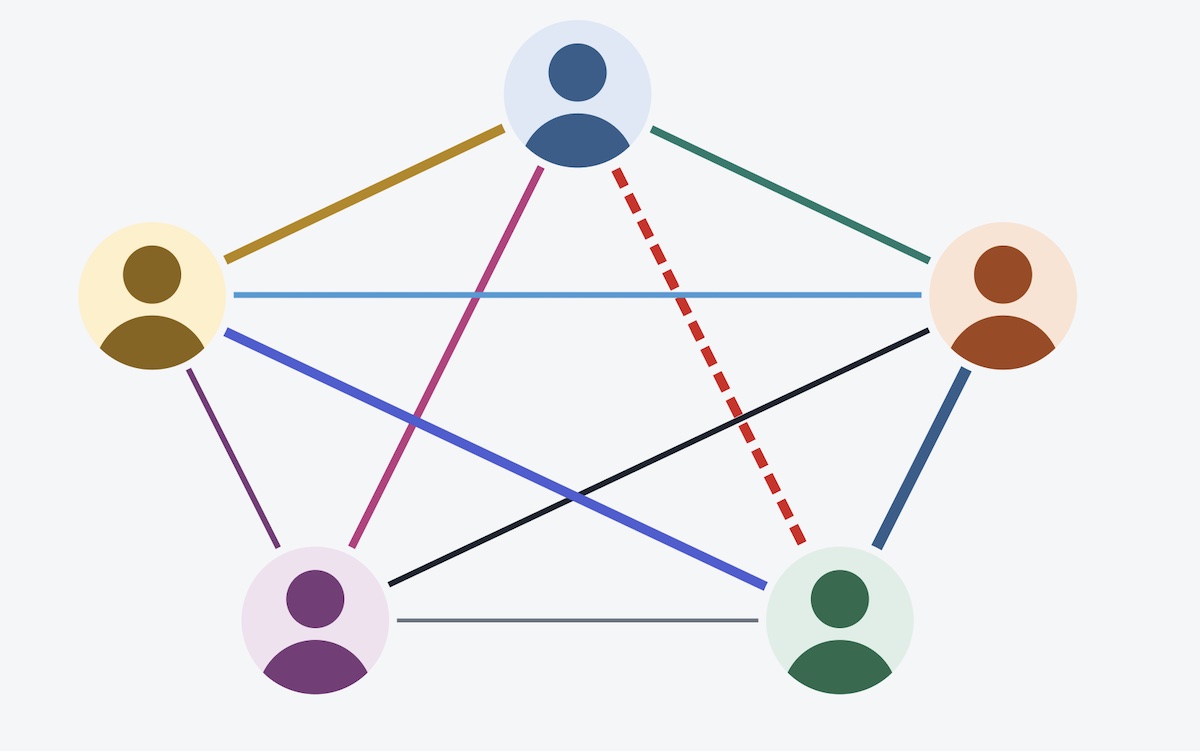
As ever, it’s important to identify the cause. When it comes to technology, unless it’s complex, you can usually pinpoint a clear cause.
When it comes to people, there can be many reasons, but the catch is that you usually can’t ask the person concerned. In that case, you need to have a good relationship with them or be very brave. Well, there are of course tricks, such as how you ask the question.
In my experience, many conflicts stem from the fact that people are different, but first I’d like to go through other possibilities so you can rule them out.
Fundamentally, there are two types of conflict – natural (healthy) ones and destructive ones. Natural conflicts can arise, for example, between sales and production. Sales want to do ‘anything for the customer’ to close a deal. Production wants to keep things simple, so that production runs efficiently. The key here is to find a balance between these interests.
Destructive conflicts can stem from many things. Fundamentally, it’s because we’re human and have reached different stages in our personal development. Sometimes, to avoid getting angry, I tend to think: Everyone is doing the best they can – even if it’s not great, for example, Mr Trump.
Sometimes people have different values and, consequently, different strategies. If another culture is involved, that may be the reason; for example, in German culture, many people are very forthright in expressing their views, whilst it is more typical of Swedes to be a bit more rounded in their approach. This means that the German person isn’t necessarily angry with you or fundamentally arrogant. It’s more a matter of a different culture of interaction.
Even if everyone involved is Swedish, the conflict may still stem from differing values. You can spot this if someone reacts very strongly to something you do or say.
Also note that certain factors favour certain values; for example, being quick is valued by the factor Power. More about the eight factors below…
Furthermore, there are ‘insidious’ causes, such as envy and jealousy. It can be subtle, but one sign may be that you feel thwarted. Normally, no one is envious of a top-level athlete, as it is so obvious that they are so much better than you are.
The risk is greatest when you yourself have succeeded at something and the other person considers themselves to be roughly equally skilled at that very thing. This can then be noticed through a lack of praise and, possibly, criticism instead. You begrudge the other person their success. This is usually a symptom of low self-esteem or what I call ‘high’ self-esteem – that is, self-esteem that is exaggerated and unfounded. People with good self-esteem find it easy to praise others honestly.
You can also gauge someone’s self-esteem by criticising them. If there is a strong reaction, you have to ask yourself: Was that reasonable? Very strong emotions suggest that you’ve triggered something.
However, there are those who are immediately inclined to examine the criticism without being aggressive. In such cases, it is usually someone with good self-esteem.
In my book Let the Personality Bloom, I illustrate this symbolically: is X an egg or a peach? The analogy is that we can all be seen as having started out as an egg at birth. Then, as we grew older, the big question arose: would we dare to transform into a peach? Or would we focus on nurturing our shell?
The peach is included because it is soft and pleasant on the surface, but its core is chiselled and powerful. This means that peaches are pleasant to be around and deal with, but if you provoke their well-founded values, you will encounter a great deal of firmness and clarity.
Jealousy is fundamentally rooted in a lack of self-worth. It’s a misconception that has become ingrained – over a long period. It must be broken somehow. Rarely is this achieved in the blink of an eye.
Then there’s something tricky… Sometimes others ask me: ‘I don’t understand why X is so negative towards me. I’ve tried to work out what it is, but I can’t.’ This may be because you’re a trigger for the other person. You might remind them of something negative, or perhaps there’s something about your appearance that acts as a trigger. In this case, if you’re in a relationship, you could ask them objectively, at an appropriate moment, about your experience.
Sometimes the simple reason for the friction is that you have different personalities and don’t understand one another. We’ll now focus on this by practising ‘personality chemistry’ à la HumanGuide.
The fundamental problem is that most people don’t know much about personality and therefore have a very limited vocabulary, which makes dealing with differences unnecessarily difficult. Everyone has a need to understand others, but if you don’t, it’s troublesome.
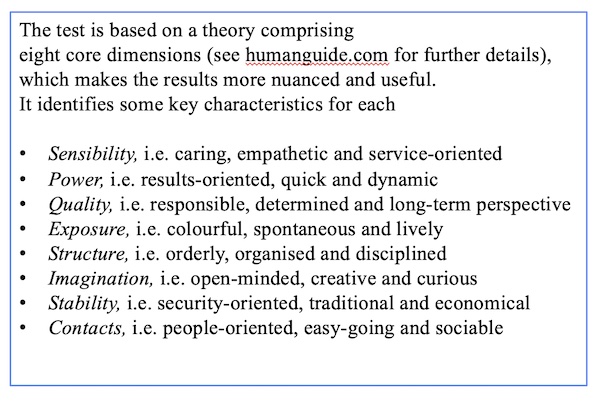
That’s why I’m now discussing the ‘Eight Boxes’ personality theory, which is at the heart of the HumanGuide concept. The underlying personality theory consists of the following basic dimensions (driving forces)
Firstly, I’d like to discuss the Law of Reciprocity. It states that similarities usually go well together. There’s also another angle to this: if A speaks highly of B, then B will usually speak highly of A. Unfortunately, the reverse is also true. Bear this in mind when you think negatively about someone. Moreover, you don’t need to show it explicitly, as the other person’s ‘radar’ will pick up on it anyway.
When it comes to the Eight Boxes, however, there is one exception. This concerns Exposure. There can be rivalry for attention. This is a risk that must be managed.
What, then, applies when there are differences in personality? Here’s an important fact – if one person has good self-esteem. Then it can work without friction, even though you’re different. Similarly, if you know each other’s profiles, you can take that into account and adapt as best you can.
Also remember that no one possesses just one of the eight factors; in other words, you must take into account all the factors a person has. However, each individual’s two strongest factors have a significant influence. These are what I call the core factor and co-factor. Even if you have a very low score on a factor, it can still have a major impact. This applies to all the factors. The ‘combination’ is what matters…
Sensibility and Power
If we start at the top with Sensibility, such people rarely cause irritation, but they themselves can harbour a great deal of irritation – internally.’
This creates a particular contrast when combined with Power. Sensibility can be really disturbed by the way Power operates, but often keeps a low profile about it. After all, Sensibility doesn’t like conflict…
It has happened that I’m due to coach a manager and find out there are complaints. For example, as I read in the media today. The head of an organisation is said to have told off staff. The media raised the issue with the manager, who then said: ‘I want to be straightforward and clear.’ Hmmm. I don’t know any more about the case, but I can imagine that the manager has Power and the employee Sensibility, which may have contributed to the problem. For someone who scores highly on Sensibility, even a raised voice can be perceived as a telling-off. There are many aspects to this. I just want to point out that personality can be the reason why problems arise.
One of the consultants, who uses the HumanGuide concept, told me about a finance manager. She put it like this: ‘When I speak to the CEO about something important, I have to use as much “hammer” (= Power) as possible’! The finance manager was pragmatic. For all eight factors, there is not only a symbolic colour but also a symbol. The aim is to make it easier to learn about the eight boxes. I like it when people talk this way, because it takes the drama out of using psychology in everyday life.
Once, I ran a leadership development programme for officers who were to collaborate with the business sector. When we got round to Power, I brought up something I call ‘communication maths’. I said: 1 = 10! Everyone looked at me blankly. Well, I said, when you say 1, you mean 10. It could be an employee who has a lot of Sensibility and a manager who has a lot of Power and little Sensibility. Then the employee might say: That decision didn’t go well, did it! What the employee actually means is that it went to hell far too quickly!
Then something unusual happened. One of the officers stared blankly ahead for several seconds. So I wondered, ‘Is he unwell?’ It didn’t seem to be the case. He explained that he’d had an unpleasant ‘aha’ moment. After we’d talked about it for a while, we concluded that it was a good thing after all, because he’d learnt something important for the future.
Quality and Exposure
Both factors are easiest to understand if you realise that, at their core, they’re about managing emotions. Quality holds onto them and Exposure lets them go – usually immediately, i.e. spontaneously.
NB! In the series here on Linkedin on the eight factors (the driving forces), I’ll be discussing them one by one. Here, the focus is on one factor in conjunction with one or more others.
Quality is usually easy to deal with, as they are ambitious and capable, and keen to conduct themselves properly. BUT if they have a firm opinion on something, they are difficult to change. That is why tensions arise, for example, between religions.
Several years ago, we had an Estates Parliament in Sweden – comprising the nobility, the clergy, the burghers and the peasants. It was decided that the minutes of their meetings should be made public. Which estate was the last to comply? It was the clergy. Why? They didn’t want to show that they were so divided…
Exposure can cause irritation in collaboration, partly because they are so spontaneous (and sometimes get it wrong), and partly because they want to be the centre of attention. Their eagerness to be in the spotlight can be irritating. Especially, of course, when what is said is irrelevant. Or when they dominate the conversation too often.
Note, however, that other factors may be mistakenly interpreted as Exposure simply because they take up a lot of ‘airtime’, since
– Quality is quite thorough when they give their responses
– Imagination, when they become enthusiastic
– Contacts, as they like to talk…
Structure and Imagination
This is about expanding the self. About developing. Put simply, one could say that Imagination inspires and Structure reins in.
This means that development begins with Imagination. If one scores highly on Imagination and low on, for example, Structure, a great deal becomes possible. This can, of course, lead to problems when working together. It may be seen as unrealistic and the like.
Furthermore, there is another obstacle involving Imagination and communication. Imagination is not always easy to follow, which is natural, as Imagination is creative and thinks differently.
It also contributes to the fact that Imagination isn’t always very precise with their words – they choose one that’s more or less right. This can cause confusion and frustration – particularly for Structure, who likes to be precise and might say to Imagination: An hour ago you said this, now you’re saying that instead. What do you mean?
When others cannot follow Imagination’s line of reasoning, they may start thinking about other things. What they should do instead is ask Imagination directly: Could you explain this more clearly? Rather than Imagination saying, in frustration, a little while later: What you’re saying now is exactly what I said a little while ago.
In collaboration, Structure can also cause irritation. Structure likes to be in control. Has devised ‘boxes’, which Structure thinks are very good. So Structure doesn’t want to change, which can become a problem. If you use Structure to get support in dealing with something, it must be perceived as support – not as unnecessary hassle. It’s important to be open to other ways of looking at things and to what provides the most support.
Structure can also be fussy about words. Sometimes that’s a good thing; sometimes it’s a matter of taste, so it’s important not to get hung up on it unnecessarily.
But remember that all traits are good. It’s all about using them correctly – and in the right measure…
Stability and Contacts
Put very simply, it’s all about Contacts. For Stability with things (objects) and contacts with people for Contacts.
Stability can be seen as a brake due to its cautious nature. It can also relate to costs or scepticism towards new ideas. Another way of looking at Stability is as an anchor – ensuring you don’t set off too quickly. Taking excessive risks and also saving costs, for example through reuse. If it’s a major decision, you can assess whether it’s possible to scale it down to reduce risks and costs.
For example… When using the Lean Startup strategy, the aim is to arrive at an MVP, i.e. a Minimum Viable Product. This reduces both costs (including time) and risks.
Contacts offer many benefits in collaboration – primarily because they aim to create a positive atmosphere. Sometimes, however, they can go too far, so that, for example, there ends up being more talk than action. In certain situations, you have to be serious – even if it can be ‘boring’.
Hopefully, you’ve now gained deeper insights into interpersonal chemistry, particularly based on the HumanGuide concept. I will now continue with the series on the eight factors in the theory. I’ll be posting roughly every other post.
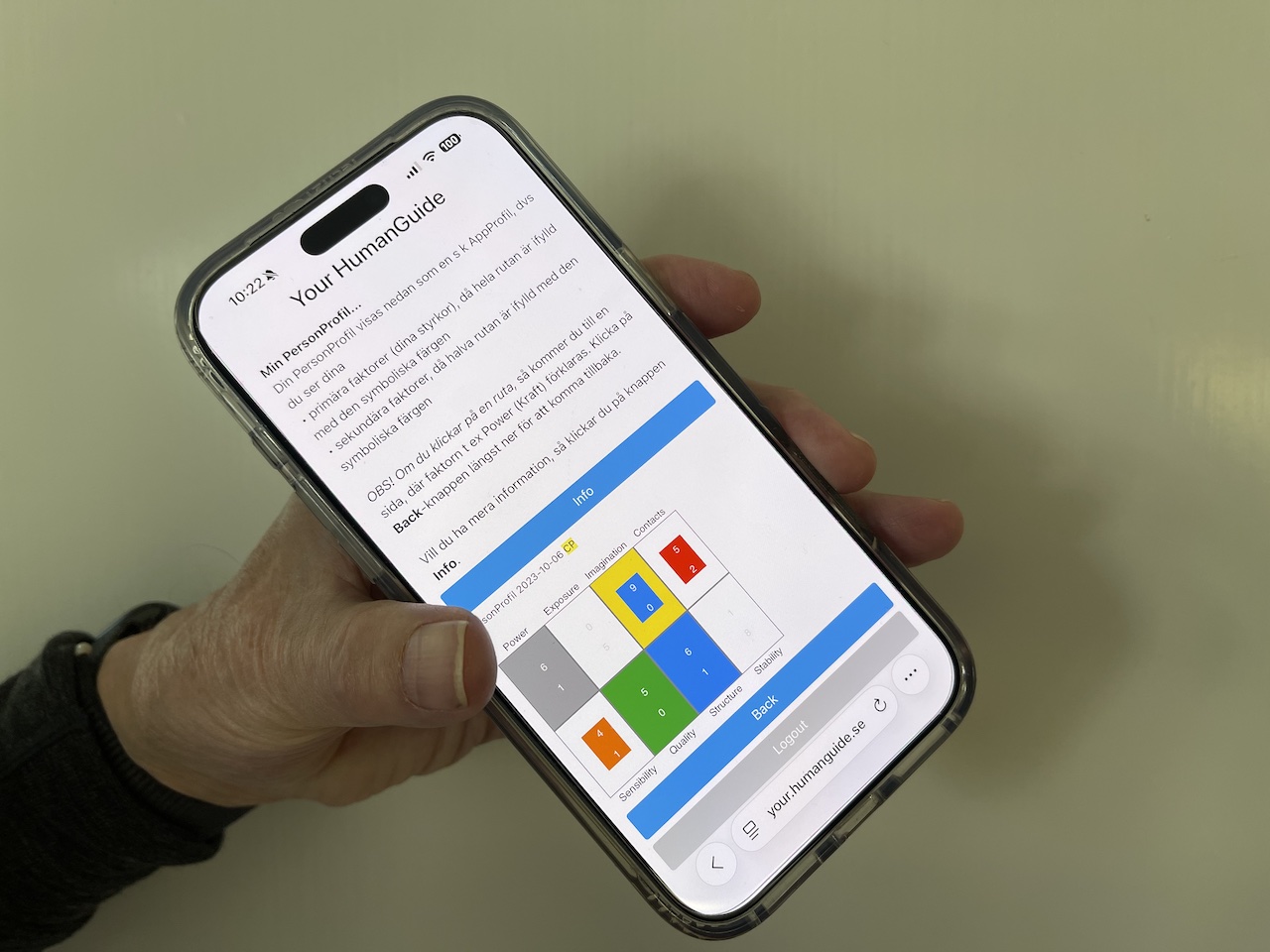
The web app your.humanguide.se
If you’ve taken the test, you’ll have access to the web app your.humanguide.se. There you’ll find a personality encyclopaedia, which means you can gain factor-by-factor knowledge about interpersonal chemistry.
Remember that diversity is a strength, IF it can be used constructively – for example, through a good understanding of each other’s personalities.
Unfortunately, many organisations recruit and staff based on a desire for security, and there is then a risk that the workforce might even end up being cloned…
Why not subscribe for my newsletter HumanGuide News? Then click here... It is on Linkedin (every second week)
- Created on .