

Gentle people are pleasant, but …

We are now launching a series of articles, each focusing on one factor at a time in the personality theory Eight Boxes. I’ll start with the first factor – Sensibility. Most of what I’ll be covering comes from my book *Let the Personality Bloom*, which is a guide to personal development. My aim is to cover all eight factors before the end of the year. In the meantime, I’ll be writing about other aspects of this area, so it doesn’t get too repetitive…
PLEASE NOTE! No one’s personality consists of just one factor, but rather, to a greater or lesser extent, all eight. However, some factors dominate whilst others are barely noticeable. This means that everyone has a sort of profile. Bear in mind, though, that this can manifest differently depending on which X factors it is combined with. And, of course, depending on whether they’re energetic or tired or…
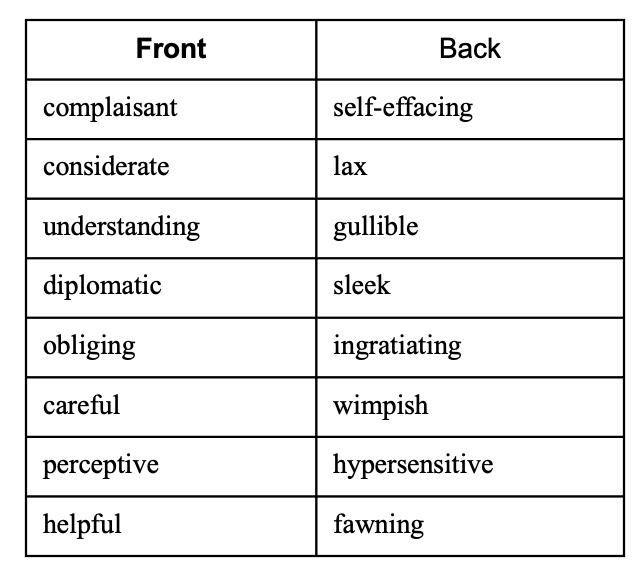
NB! All traits are neutral; in other words, it’s how you use them that determines whether they’re positive or not. For example, if someone is meticulous and time is of the essence, others might find that same person – fussy. That’s why, for each factor, I’ll discuss such pairs of opposites.
Remember to focus on the positive version. Focus, so to speak, on the healthy plant – avoid feeding the weeds. Support others’ progress and, of course, your own as well.
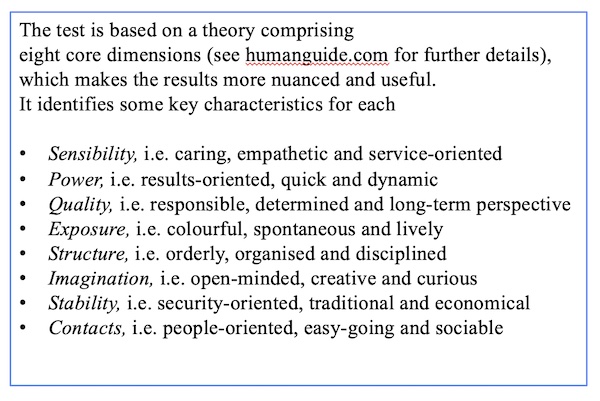
I’ll also discuss how best to take into account someone who is dominant in a particular factor. What should you bear in mind in that case? Here is a table showing all eight factors.
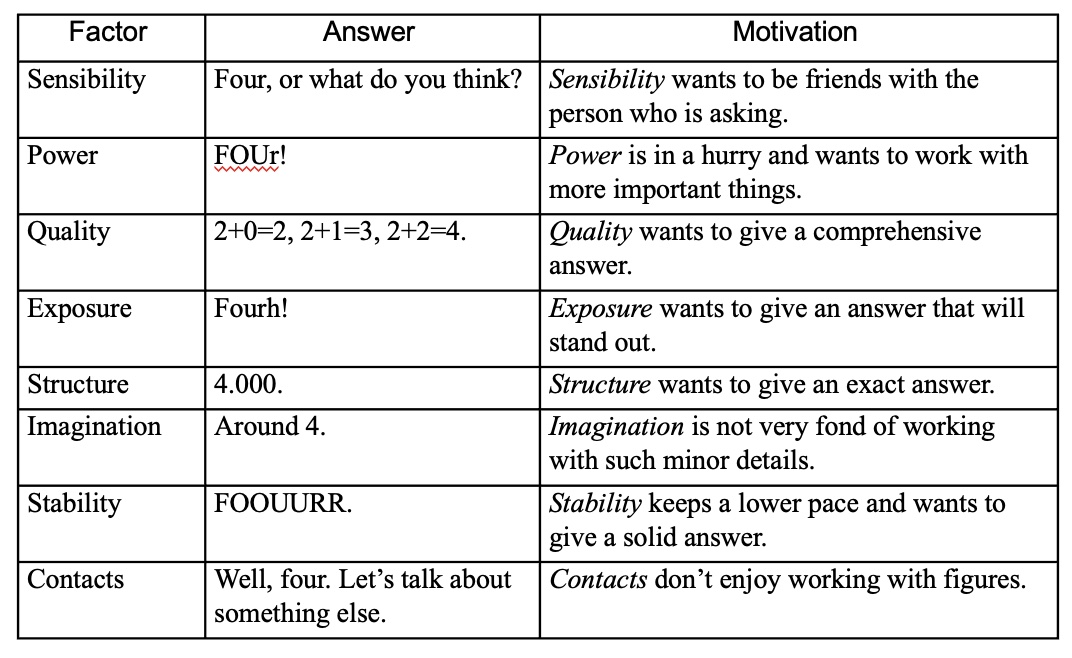
There is also a ‘popular version’ of the eight boxes
It is based on a story about a managing director, who came up with the idea of asking the others in the management group what 2+2 is. The financial manager answered: ”What do you want it to be?” The production manager answered: ”4.000.” The R&D manager answered: ”Around 6-7. Do you want me to look into this?”
If you were to ask someone who is dominant in either of these factors, what would their answer be?
Now to Sensibility…
Typical of the factor is
The symbol above has been chosen to make it easier to remember what is typical of the factor. the HAND WITH THE HEART has been chosen as a symbol for care and service.
The colour orange, which should be used to colour sensibility in all material for the concepts, symbolizes warmth. There are many different schools concerning what effect colours have. It is therefore impossible to say what is right and wrong in terms of symbolism.
Concerning the front it is important that people with sensibility use their considerateness and warmth to establish a relation, the diplomacy so as to avoid unnecessary conflicts, the perceptiveness to catch weak signals, etc. People with sensibility enjoy a soft and warm atmosphere.
Note! There are no people who have only sensibility, but I have chosen to generalize in this way in order to make the text more easy to read.
When the recipient has a great need of sensibility it is important to tread carefully. He or she finds it difficult to say no and give unpleasant information to others. This means that a piece of advice, which involves a negative confrontation with OTHERS, may be hard to follow. Sensibility has to learn that it is very difficult, for practical reasons, to be friends with everybody. It would require too much time. In a group of 20 people there are 190 potential pairs, and if you are to maintain friendship you need to continually spend time only the two of you. A more reasonable ambition is to have few friends, relatively many acquaintances and many contacts.
One tip is to bring up the expression ”inconsiderately considerate”. This means: Tell someone if you are annoyed with him/her, otherwise he/she won’t get the chance to change. Not to inform about the problem can be inconsiderate, i.e. when there is an opportunity to bring up the problem constructively. At worst, such failure to inform can lead to the person in question being ostracized, without him or her even knowing the reason for it.
A suitable coaching strategy for a person with a great need of sensibility, can be based on development, which makes life better for others. Or to make sensibility aware of the risk of being burnt out. In the latter case one method is to point out that they are being unreasonably helpful. You could explain that it is unreasonable to visit a seriously ill friend every day, if it is someone you normally don’t meet more than once every three months. Naturally, it is difficult to set standards for these kinds of things, but it is wise to once in a while consider what you are doing.
Another way to avoid guilt or exaggerated responsibility is to think about how you care for your nearest and dearest. It makes sense to suggest that they should be one’s top priority.
Since the relationship to his or her body is so important to sensibility, it may be worthwhile to learn relaxation, meditation or something similar. This will teach sensibility to handle all the tensions, which arise because of their great sensitivity.
It is important that sensibility understand the consequences of their physical sensitivity, since they may feel uneasy without actually being ill. This could be due to the mood in a group. There may be uneasiness, conflicts, etc. But sensibility also needs to listen to ”calls for help from their body”. If not, sensibility can easily get burnt out – at least in the long run.
Another characteristic is the fact that sensibility usually has a highly developed sensory memory. It is useful for them to try their hand at something in a concrete sense. This helps them to remember. Chefs and wine tasters, who have a developed sensory memory, often have sensibility as a dominant factor.
Sensibility can sometimes be a problematic factor concerning masculine and feminine. By this I mean that sensibility is a factor which many people associate with femininity. Men may suppress their need for this factor to avoid accusations of being feminine. Similarly, it may be a problem for women who have little need of sensibility, since they may be perceived as unfeminine.
The greatest concern for sensibility in terms of stress is the fact that sensibility give too much of themselves to others. There is no limit to their considerateness. Sensibility can also experience stress when someone is being brusque towards somebody else. Another type of stress occurs when sensibility can sense other people’s troubles because of their great sensitivity. To sum up, the risk can be described as a sensitivity exaggeration.
Note! Someone has pointed out that the concept of an exaggeration can become a self-fulfilling prophecy. Undeniably, there is a risk, but you can choose to look upon the concept from another point of view. When you know what “disease” you have you also know what to cure, and it will be easier to find the right remedy. You can think of the relief you experience when you are told that you have appendicitis, compared to the prior situation when you were worried about the pain in the stomach.
Note! There is another thing to be observed concerning an exaggeration, which is when a factor has a too dominant back. Another aspect of this is that the factor is not satisfied, which means that the exaggeration can be compensated for by satisfying the need of the factor in a better way, in the case of sensibility for example by developing close relations.
Being firmer towards others can neutralize a sensitivity exaggeration, but this isn’t easy for sensibility since it often means that someone will be dissatisfied. One way to go is to change sensibility’s attitudes, as in the example above: The person who doesn’t voice his or her discontent is being ”inconsiderately considerate” and will not allow the other person the chance to change. He or she may also try to learn some technique for negative and constructive feedback.
When under stress sensibility can benefit from using relaxation and meditation.
When someone undertakes to manage his/her stress it is sensible to do it in steps – this is particularly important to sensibility, since the strain may become too great and it is easy to end up in a vicious circle.
Finally, there is the concept of HSP (Highly Sensitive People), i.e. people who place a high value on sensibility.
Please note! Our website, humanguide.com, contains a wealth of information; to make it easier to use, there is a useful search function.
To our success,
Rolf
Why not subscribe for my newsletter HumanGuide News? Then click here... It is on Linkedin (every second week)
- Created on .