

Does X, or do you, actually have ADHD??
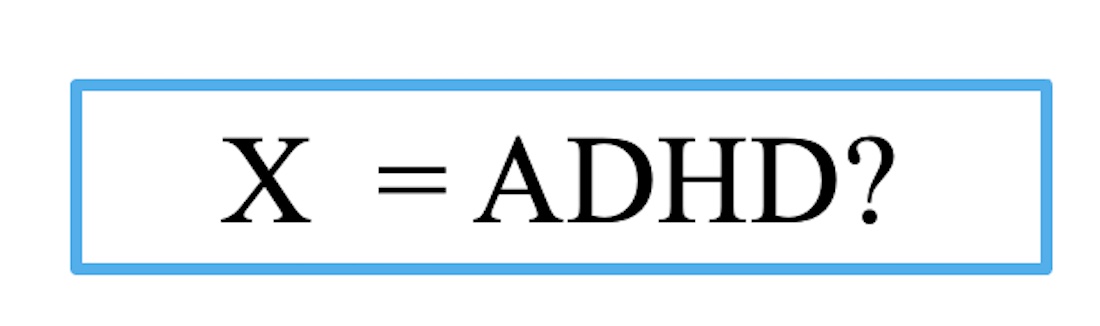
It makes me angry when people blurt out things like: ‘X has ADHD’ or some combination of letters. Not only is it negative and can become a self-fulfilling prophecy, but it’s also belittling and vague. The person is reduced to a single defining characteristic. It’s a bit like saying that all left-handers are the same… Is that really the case?
In many cases, I have my doubts. Even when they have been diagnosed, for instance after I had read the book *The Art of Faking Arabic* – a book about autism (in Swedish). The book was written by a woman who attempted to take her own life several times. She received treatment, but it didn’t work. One young doctor was even troubled by the fact that various types of treatment were often not very successful. He remarked, amongst other things, ‘We’re just shooting in the dark. If that pill doesn’t work, we’ll have to try another one…’
It was a stroke of luck that an aunt was listening to the radio, where they were discussing autism in young women. She felt that this applied to Lina, the book’s protagonist. Lina then received help, partly through a better understanding of her own way of being, and was able to act accordingly – for example, realising that certain situations can be demanding for her, so she needs to avoid them or adapt.
Why is that the case? Most people aren’t very good at describing people’s characteristics. A lack of words and knowledge. But everyone has a need to understand and describe others. It’s important!
For example, it annoys me that many people think my wife and I are very different. I can talk a lot and very animatedly – especially when I’m enthusiastic. My wife talks much less. So we’re very different…
However, this isn’t true if you use the ‘Eight Boxes’ personality theory (more on that below), on which the HumanGuide test is based. Of the eight basic dimensions, three are similar and in two we complement each other.
I’ve brought this up because my view is that, in a relationship, partners should have similar personalities. This is backed up by research. There’s a strong logical argument here: if you’re different and have free time together, you’ll probably want to do different things. So why be together?
So how can one describe people’s personalities?
One notices the lack of vocabulary and knowledge about personality when some people still use astrology to consider whether ‘Leo’ X would make a good partner? Or whether X is red or yellow according to DISC or similar models. It all becomes unclear and uncertain.
Many psychologists favour personality tests based on the Big Five model. It is not primarily intended for use by laypeople. For example, neuroticism is one of the five core dimensions – who would want a high score on that? There is even a risk that it could become a negative fixation. Another drawback of tests based on the Big Five is that they rely on statistics – not on any personality theory. This means that, with such a test result, one can only say that X is likely to do this or that, but not why.
Since 1986, I have gone through the results of the HumanGuide test with at least 5,000 people during face-to-face meetings. Occasionally, someone has mentioned that they have been diagnosed with ADHD. The interesting thing is that in such cases, the results have not been particularly consistent. Why is that, I have wondered? I have come up with various explanations. It is a vague diagnosis, so ultimately, it comes down to a subjective assessment. It’s different from taking a temperature: if it’s 39, you have a fever. Full stop.
Since 1986, I have been developing the HumanGuide concept, at the heart of which lies the test. The aim is, amongst other things, to improve people’s self-awareness, so that they can make better decisions in their lives regarding suitability for jobs and life partners, as well as having a healthy relationship. The concept can, of course, be applied in the workplace.
The test has the advantage of being based on a theory with eight fundamental dimensions. This results in a more nuanced test result, providing clearer insights.
Back to ADHD…
ADHD is a behavioural pattern with certain characteristics, but it is not particularly distinct. I know that an ADHD assessment is very resource-intensive. If carried out privately, it costs a great deal of money. If I remember correctly, it cost 30,000 SEK for Carina Bergqvist (SVT) in her series on ADHD.
People with ADHD are considered to face two challenges
- Managing all their energy, for example, sitting still for a long time
- Staying focused on something
With ADHD, these two characteristics are emphasised. You can be very active and intense. You lack focus. We can all be like that from time to time, but at a certain level it becomes an increasing problem for the individual and also for those around them. In such cases, medication can be helpful. Furthermore, gaining a deeper understanding of one’s personality can provide valuable support.
I’m now going to discuss ADHD using the ‘Eight Boxes’ personality theory
The theory underlying the HumanGuide test is known as the ‘Eight Boxes’. Here is an overview, as I will be using these eight factors in my argument.
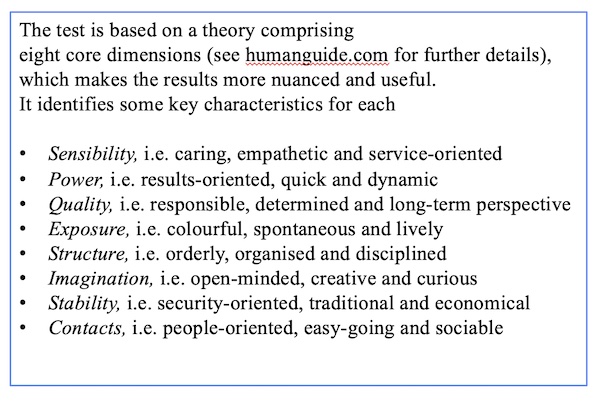
NB! These factors are driving: Power, Exposure, Imagination and Contacts; in other words, if you have the greatest strengths in these areas, you’ll end up like Mr Trump in the US. He is the extreme embodiment of US culture.
These factors are reflective (people often think things through before they act): Sensibility, Quality, Structure and Stability. Anyone in whom these factors are dominant can be likened to Ove from the book and film *A Man Called Ove*. Ove is the extreme embodiment of Swedish culture.
Remember that all traits are good. It’s all about using them in the right way. If someone is meticulous, people like that, but if they’re in a hurry, the same person is seen as fussy.
So what is it that can create the impression that someone has ADHD? Those who have been diagnosed with ADHD share certain common traits in the test, such as a lack of ‘Structure’. This can make it difficult to stay focused – one of the eight factors in personality theory. Another person might score low on ‘Structure’ and high on ‘Power or ‘Imagination’, and so on.
When it comes to Imagination, that driving force means wanting to develop through new insights and experiences. That’s when you can become really enthusiastic about something. You get completely absorbed in it. Then others might say – as Carina B has often been told: ‘You’re too much’ For example, I learnt about at least 25 different mushrooms from a friend, after initially only knowing three. THAT’S when I became really enthusiastic and could barely keep my eyes on the road whilst driving in the autumn – I kept wondering, ‘Could there be mushrooms in this forest?’ Some might see that behaviour as ADHD…
Another possible explanation for the high pace and intensity is that someone might sometimes be experiencing a touch of mania. I say ‘a touch’, because when it comes to people, the strength of these driving forces also varies – just like body temperature. When someone reaches such a high level that it becomes a problem, then you could say that X is mentally ill.
The Eight Boxes is a simplified version of Leopold Szondi’s (1893–1986) theory of personality. He was a Jewish doctor, who today would probably be regarded as a psychiatrist. He was interested in genetics. One day, he observed a pattern in mental disorders based on psychological functions that had reached an extreme state. For mania, I have termed the ‘normal’ function ‘Contacts’. The eight factors (basic dimensions) in the theory are arranged into four vectors. In this case, ‘Contacts’ is linked to ‘Stability’, which corresponds to the mental disorder known as depression. When one has problems with these, one is manic-depressive. The behaviour is logical, because when one acts manically, a great deal of energy is expended. When energy levels are running low, one becomes depressed. A person who had been hospitalised for depression mentioned to me that after she had slept for more or less three days, she had recovered.
When you want to understand what has happened or is happening, it is important to consider the whole person when trying to make sense of your own behaviour or that of others.
My hope now is that you, the reader, will gain a more nuanced understanding of ADHD.
I believe in the principle that a good description of a problem is half the solution. This means that if you have been diagnosed, you need to explore it in greater depth – for example, by gaining a clearer picture of your personality – so that you can understand why your behaviour may be consistent with ADHD.
It’s common for people to suggest that entrepreneurs have ADHD. After all, they do like to break new ground. If you’re interested, I’ve written a paper entitled ‘Why do some entrepreneurs fail whilst others succeed?’. You can find it on my website, humanguide.com, under the ‘Free Knowledge’ and ‘Business & Organisation’ tabs.
Finally, I would urge you to be more cautious about labelling someone as having ADHD. As someone once said: ‘If you don’t have anything nice to say about someone else – don’t say anything at all.’ After all, everyone does the best they can – even if it’s not very good, as in Mr Trump’s case.
Generally speaking, I’d like more people to be more tolerant of difference. Everyone has their pros and cons. Or as Szondi said: ‘To me, no one is mentally ill. People have simply progressed to different stages in their humanisation.’ Unfortunately, there are many people diagnosed with ADHD who don’t dare mention it to, for example, their colleagues. They ‘pretend’ to be OK just to fit in. Just think what a huge, unnecessary burden that is to bear.
What can you do to deal with this sort of worry?
My suggestion is to take it step by step…
The first step is to gain a better understanding of your personality and the implications this has – for example, by taking the HumanGuide test…
The second thing is to accept that it is what it is, as personality is based partly on one’s genes – to about 50 per cent – and the rest on one’s environment (one’s experiences). This means that it remains fairly stable once you reach adulthood, which makes it easier to accept your personality rather than trying to change it.
But there are, of course, exceptions, as there always are when it comes to people. However, it is important to bear in mind that if the environment has had a significant influence on someone, this has led to habits forming, and it is not always easy to change them. Another reason for exceptions is that, for some reason, a person has repressed a particular trait – for example, a man might repress his need for Sensibility because he feels cultural pressure to be ‘masculine’, or similarly, a woman might do so with regard to Power.
Other measures depend more specifically on which factor is one’s greatest concern.
If you have a high score for Power, Imagination or Contacts and a low score for Structure, you can ensure that you have better control and that you do not take on too much at once, for example
– making the most of suitable computer programmes
– having rules of thumb for how many projects you should have on the go at the same time
– having three ‘power goals’ to help you stay focused and make it easier to say no – based on the book *Powergoal*
– having ‘rules’ for recovery
– seeking feedback from those around you
– etc.
Please note! Our website, humanguide.com, contains a wealth of information; to make it easier to use, there is a useful search function.
To our success,
Rolf
Why not subscribe for my newsletter HumanGuide News? Then click here... It is on Linkedin (every second week)
- Created on .