

AI opens up so many more possibilities, but…

There is currently a lively debate for and against AI. Who is right and who is wrong? For a layman, it is impossible to tell. Besides, it’s always the same with new technology. Some see dangers and others see opportunities. In fact, it is always easiest to spot the dangers.
People are generally more inclined to see risks in the unfamiliar. Moreover, when there is a lack of information, rumours arise. And many people confidently express opinions on matters they probably know very little about.
As someone wrote the other day – the interesting question is how we can benefit from AI. Another person pointed out that new technology can create problems, so it’s important to be vigilant, to test that it works as intended, and to develop safeguards. And to take decisive action when errors are detected.
On the other hand, it’s rare for something new to immediately turn into a disaster. Look at social media. We’ve now realised that social media can cause problems. Compare this with the current decline in smoking. There are several examples.
When someone starts to perceive a risk associated with new technology, it can amplify concerns, leading others to reinforce that perception even further. This leads to an obsession with obstacles.
If, instead, we look at the opportunities, I’m reminded of the expression – the global village. Now we have the global library, which offers fantastic opportunities.
When IT first arrived, people talked about ‘BC’ and ‘AC’ – that is, whether you were born ‘before computer’ or ‘after computer’. Those who were ‘BC’ and of a certain age often wanted to avoid having to learn the new technology. On top of that, they had to buy an expensive computer. Unfortunately, I still come across people who are ‘BC’ and avoid using IT as much as possible. This becomes a handicap and fuels ageism.
This time round, the barrier to entry is much lower. I’m surprised by how many people aged 40 and over are using AI. This can apply to:
– practical matters
– various types of knowledge
– etc.
It’s a bit trickier when it comes to getting help with routine tasks, but I expect that area will also grow soon. Of course, there’s a risk that jobs will disappear, but on the other hand, new jobs are being created. More time can be spent on more creative tasks or those that cannot be handled by a computer.
In any case, as always, the key is to ‘make the best of it’ – that is, to make the best possible use of the new situation.
My business is all about taking people’s differences in personality into account, so that we can find the best possible match, for example for a job. Major mistakes have been made here when introducing new technology. Take, for example, when they stopped printing newspapers; a new job was created to manage this via a computer. When you use lead type for printing, it’s a tangible job. Hands-on. When you do it on a computer, it’s abstract. In many cases, this led to a mismatch with the individual’s personality. It is therefore not enough simply to learn how to use a computer in order to feel fulfilled at work. It would be beneficial if more people thought along these lines, now that AI is set to be used to an increasing extent. It is essential to take into account the personalities of those affected; otherwise, one risks gradually causing mental ill-health.
So how do different personalities react to new technology, and specifically to computer use? As usual, I’m drawing on the ‘Eight Boxes’ personality theory. See below. I’ll then give my view on how the eight different factors (driving forces) are likely to perceive AI. Please note that I’ll take one factor at a time, but no one’s personality consists of just one factor. However, one or a few factors tend to dominate – one’s strengths – so it’s important to consider the whole picture.
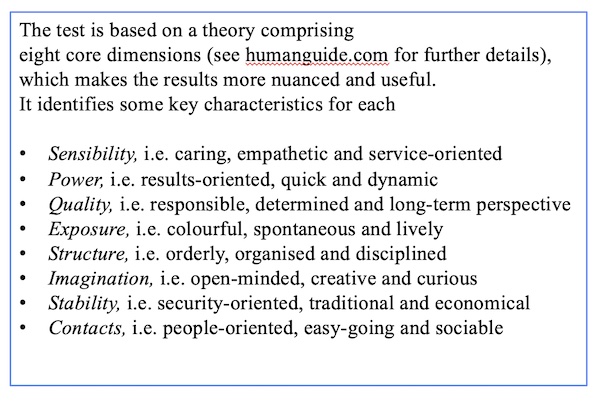
Sensibility
Fundamentally, they are not in favour of technology, which is abstract. They want to experience things with their senses. To be mindful of their feelings. To achieve harmony. However, as with everyone, it comes down to what’s on both sides of the scales. What do I gain, and what is the cost? The latter also involves learning something new.
Power
They like things to move quickly and to see results, but it mustn’t be complicated to use or to learn.
Quality
They may appreciate that it’s resource-efficient… However, there’s a contradiction here in that electricity prices may rise, which could lead to high costs for the retail market. This may be seen as unfair. They may appreciate that it can, for example, lead to better decisions, but naturally dislike the fact that AI can make mistakes…
Exposure
Generally speaking, they don’t care much about the wider benefits, as long as they can benefit from AI themselves. Furthermore, it is important for Exposure that they keep up with the times, so they don’t get left behind. After all, they want an audience.
Structure
Unlike Sensibility, they like IT. They like that it is well thought-out and logical. Predictable.
Imagination
They like new things. Coming up with new applications. However, they don’t like it if the new thing is complicated to use and learn.
Stability
They are cautious about new things. Cautious. They want to feel secure, so they usually come round after a while. There is a risk that they’ll lag behind…
Contacts
They’re not particularly keen on technology, but, as with Exposure, they naturally become interested if they stand to gain significant benefits – for example, being spared from doing things they find boring.
What is your attitude towards AI?
For our success,
Rolf
Why not subscribe for my newsletter HumanGuide News? Then click here... It is on Linkedin (every second week)
- Created on .