

Do you have a positive attitude towards personal development? Does it work?
Professor Carol Dweck in the US divides people into two categories based on their mindset: fixed and growth. According to her research, the fixed mindset is the most common. This means that one’s personal development is, to some extent, limited. This is particularly true in areas where one excels, because if one challenges oneself in those areas and things do not go well, it takes a heavy toll on both self-confidence and self-esteem. That is why people are reluctant to take that risk.
Why has it turned out this way? From childhood onwards, people are encouraged to perform. For example: ‘How did you get on in the exam, the match, the trials, etc.?’ The consequence is that a performance-based self-esteem is reinforced. It’s all about always being good at things. As a result, people become afraid of failing. You become particularly afraid to challenge yourself in an area where you’re especially good. After all, failing there would be devastating.
The consequence is an obstacle to personal development. ‘This is who I am. Full stop.’
This has an impact on society. Everyone’s in a rush, because you have to perform to be ‘OK’. It’s no wonder so many people look forward to retirement. To ease the pressure.
What’s the alternative? Well, to focus on a value-based self-esteem. It’s OK simply to exist and to do the best you can.
You should think particularly carefully when it comes to your children. Don’t just comment on their results. It’s important to tell them that you like and love them. They don’t have to achieve this or that for you to like them.
It’s likely that most people with a ‘growth mindset’ have had good support from their parents. Particularly when it comes to developing themselves. To dare to try.
These people are curious. Open to development. Keen to give things a go. They realise that you don’t become good at something straight away. You have to learn and practise.
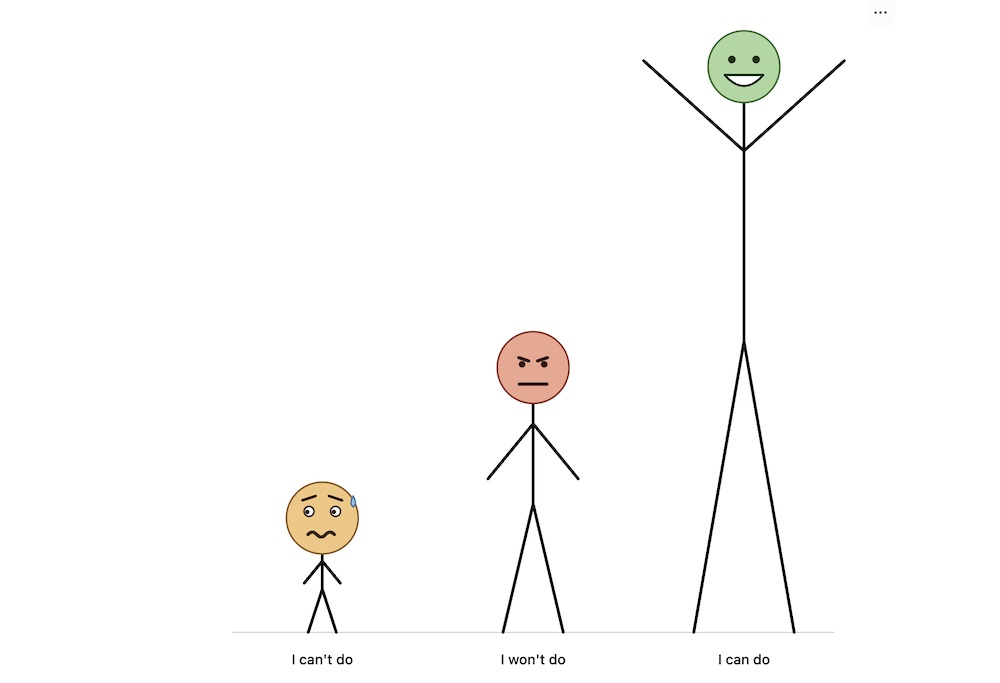
A fellow consultant in England – Graham Williams, sadly now deceased – took Dweck’s approach a step further. He divided the ‘fixed mindset’ into two distinct attitudes, resulting in the following breakdown:
– ‘I can’t’ do; – those who lack self-confidence, i.e. who tend to say ‘yes, but…’
– ‘I won’t do’, those who want to be in control and are reluctant to follow others’ proposals – they, too, are inclined to say ‘yes, but…’
– ‘I can do’, which is the same attitude as the growth mindset, i.e. they usually say ‘Why not?’ when opportunities arise.
If you want to support the development of those with an ‘I can’t do’ mindset, you must boost their self-confidence.
As for the ‘I won’t do’ type, you need to make them aware that their attitude is hindering their development, as they tend to say ‘no’ to most suggestions…
And for the ‘I can do’ type, it may be more appropriate to carry out a risk analysis from time to time or to take the odd break. I’ve written before about the benefits of ‘bubble hopping’. The ‘I can do’ type likes this, but sometimes it might become too much… They might benefit from the advice in their colleague’s book *Powergoals*. It’s good to have three as a guide to steering your life. If you only have one, life becomes like a tunnel. Ten means you lose all focus.
Which attitude do you usually have?
Please note! Our website, humanguide.com, contains a wealth of information; to make it easier to use, there is a useful search function.
To our success,
Rolf
Why not subscribe for my newsletter HumanGuide News? Then click here... It is on Linkedin (every second week)
- Created on .